Connectivity-Influence Weighting: A Structural Bias for Graph-Based MARL
Jan 9, 2026· ,,,·
0 min read
,,,·
0 min read
Reda El Marhouch
Salah Chegri
Btissam El Khamlichi
Amal El Fallah Seghrouchni
Abstract
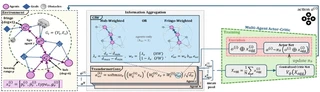
Graph neural networks used for multi-agent reinforcement learning typically treat every edge of the communication graph as equally important. This paper introduces connectivity-influence weighting, a structural bias that weights messages by the connectivity and influence of the agents exchanging them, improving coordination and scalability in partially observable settings.
Type
Publication
IEEE 23rd Consumer Communications & Networking Conference (CCNC), 1-6
Status
Peer-reviewed

Authors
Ph.D. Student in Artificial Intelligence
I am a Ph.D. student in Artificial Intelligence at Ai Movement, the International Artificial Intelligence Center of Morocco at UM6P. My research interests are multi-agent reinforcement learning, graph-based communication between agents, and heterogeneous swarm coordination — in particular how structural priors over an agent’s communication graph can make coordination scale under partial observability.
Before starting the Ph.D. I graduated from the School of Information Sciences (ESI) as a Data and Knowledge engineer, and worked on applied computer vision and conversational AI.